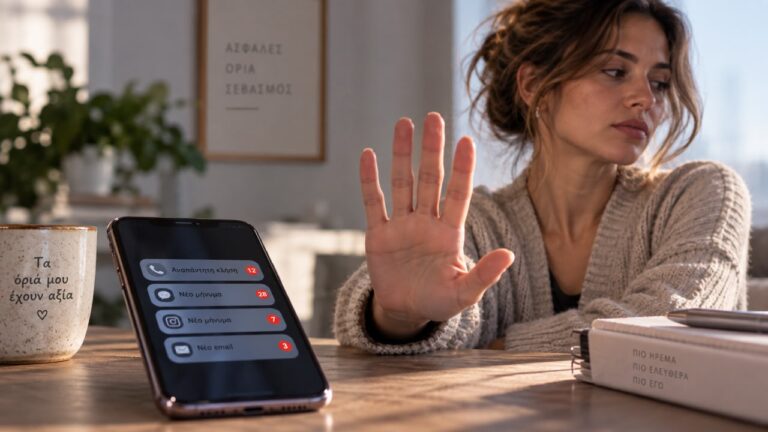

The mobile phone has become an integral part of our everyday lives. We communicate, work, keep informed, use social media and stay connected with the people around us. But what happens when the thought of being without our phone causes intense discomfort or anxiety?
Nomophobia describes the anxiety or distress a person may feel when they do not have access to their phone or cannot use it. It may be linked to the fear of not being able to communicate, of losing touch with others, of not having access to information, or even to the upset caused by losing the convenience the phone brings to our daily lives.
What did the research in Cyprus show?
In a study of 300 adults living in Cyprus, almost all participants showed some level of nomophobia, and more than half were at a moderate level. Higher levels were found among younger adults and women, while using the phone for communication and social media was also linked to greater nomophobia.
Another interesting finding concerned the way we deal with difficulties and stress. Less helpful, more avoidant ways of coping were linked to higher levels of nomophobia.
It is not only about the time we spend on our phones
A second study of adults in Cyprus looked at nomophobia in relation to loneliness, the way we connect in our close relationships, and the time we spend on our phones.
The results showed that as phone use increased, so did levels of nomophobia. At the same time, higher nomophobia was linked to greater loneliness and to more insecure attachment patterns in close relationships.
These findings invite us to look a little more deeply at our relationship with our phones. What matters is not only how many hours we hold a screen in our hands, but also what we may be looking for in it: communication, connection, relief from loneliness, or a way to step away for a while from difficult feelings.
The phone itself is not the problem. It is a valuable tool of modern life. What may be worth noticing is the relationship we have developed with it and the role it has taken on in our own daily lives.
So perhaps the important question is not only:
“How much do I use my phone?”
but also:
“What does it mean for me not to have it?”
Related publications
This article draws on findings from published research in which I took part as a researcher:
Mousoulidou, M., Constantinidou, E., Christodoulou, A., & Siakalli, M. (2025). The prevalence of nomophobia in Cyprus and its relationship with coping styles. Frontiers in Psychology, 16, 1538155.
Constantinidou, E., Mousoulidou, M., Christodoulou, A., & Siakalli, M. (2025). Nomophobia, attachment styles, and loneliness: A study among adults in Cyprus. Psychiatry International, 6, 113.

Counselling Psychologist in Limassol. Person-centred approach with a psychodynamic and systemic perspective.
About me →